The Underground Basilica of Porta Maggiore
Few places in Rome show the overlap between the ancient and modern city as clearly as Porta Maggiore. Aqueducts, walls, consular roads, railway lines, tram routes, traffic and service buildings meet in the same compact urban area. Yet one of the most remarkable monuments of Roman architecture is not visible at all: it lies below the present ground level, behind a modern brick access building on Via Prenestina.
The Underground Basilica of Porta Maggiore is a hypogeal monument of the 1st century CE, probably built in the first half of the century and used for a relatively short time. It is an apsidal rectangular hall, divided into three aisles and decorated with stucco, painting and mosaic. Because of its form, the quality of its decoration and the uncertainty surrounding its function, it remains one of the most debated monuments of underground Rome.
The images in this article are original schematic drawings and reconstructions created to help readers understand the monument. They are not official surveys or documentary photographs, unless explicitly described as photorealistic reconstructions. They are based on available information, bibliographic comparison and reference images, and may therefore include simplifications, approximations or interpretive choices.
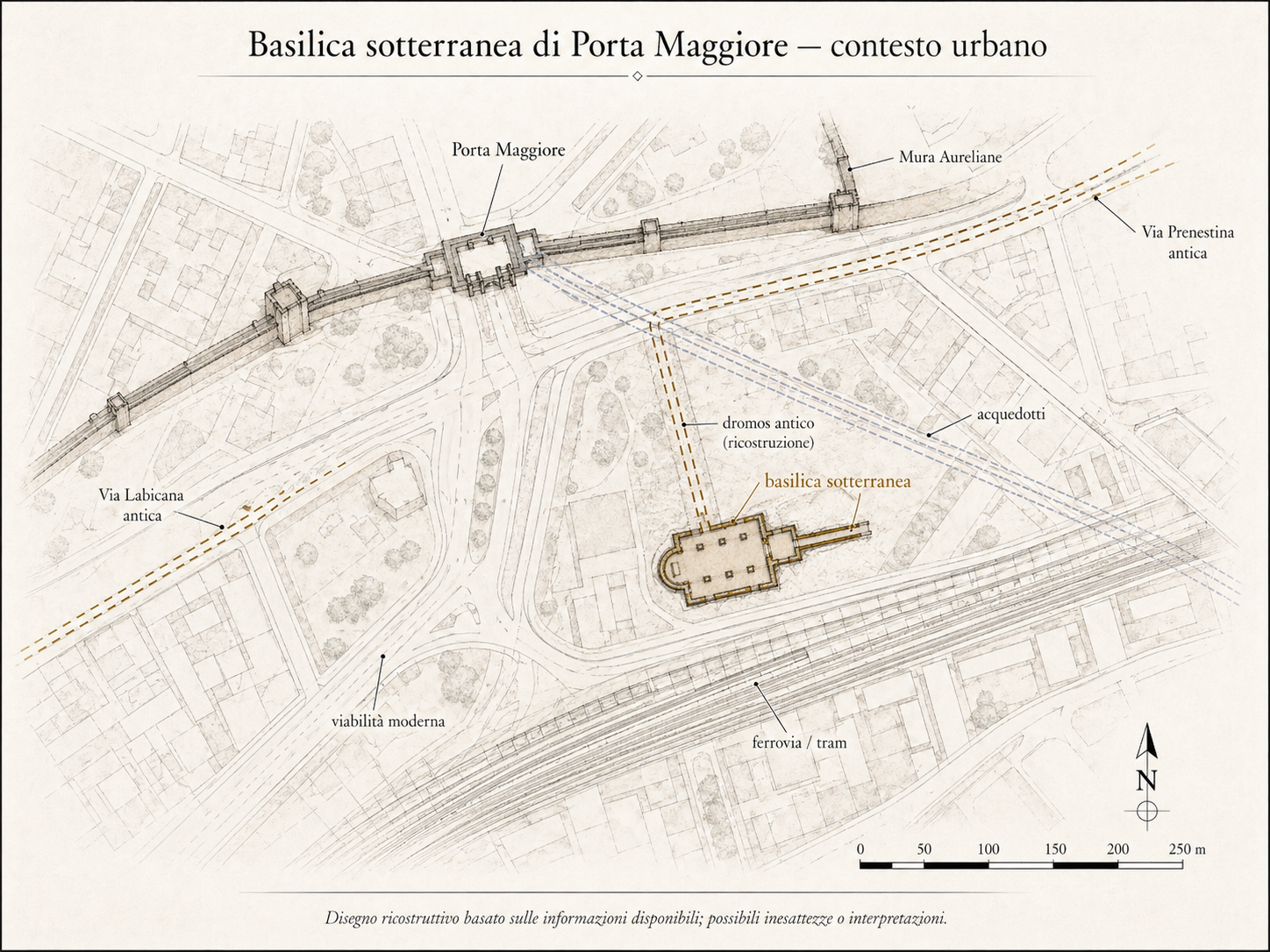
A monument discovered by accident
The monument was discovered in 1917 during works connected with the railway near Porta Maggiore. The collapse or failure of part of the vault revealed an exceptionally decorated underground space. Subsequent studies, especially those by Goffredo Bendinelli, turned a construction-site discovery into a major archaeological case.
The basilica lies near Via Prenestina, not far from the monumental aqueduct display later incorporated into the Aurelian Walls and transformed into the city gate now known as Porta Maggiore. In the imperial period this was an outer or marginal sector in relation to the densest urban core, crossed by important roads and water infrastructures.
The basilica was not visible like a temple or an ordinary public building. Its hypogeal nature was part of the design itself: the ancient entrance consisted of a long sloping corridor, or dromos, descending toward a vestibule and then into the main hall. The present entrance is not the ancient one; it is a modern access route created to allow inspection, maintenance and controlled visits.
Plan and internal organization
The best-known part of the monument is the basilical hall: a rectangular room of about 12 by 9 metres, ending in an apse. Six square piers divide the space into three aisles, with the central nave wider than the side aisles. The ceilings are vaulted, and the whole arrangement suggests a sophisticated geometric design.
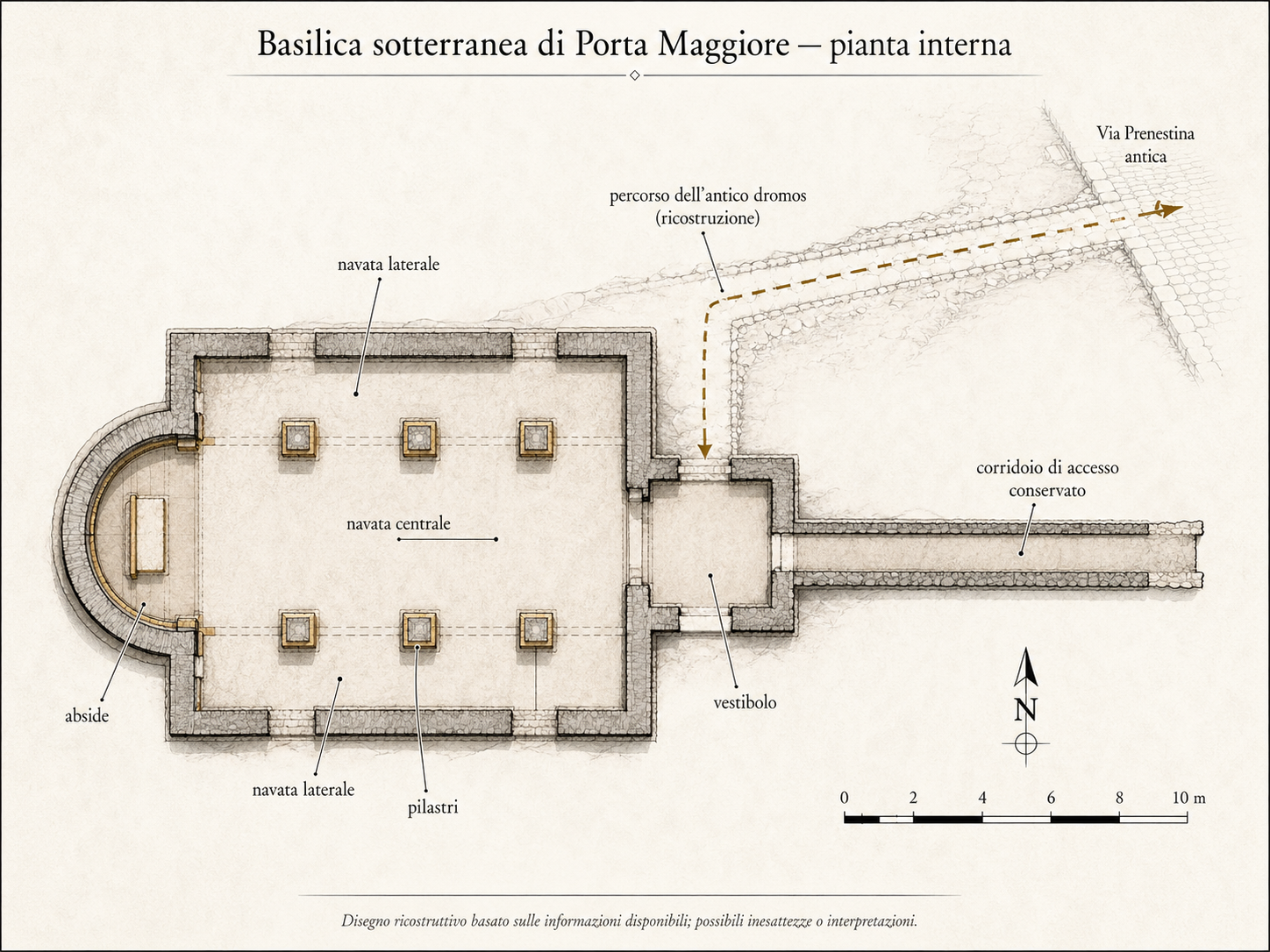
The resemblance to later Christian basilicas is evident, but it should not be read anachronistically. The Porta Maggiore basilica predates the Christian monumentalization of the basilical form. It belongs to a pagan and probably initiatory context, in which the aisled hall did not serve Christian liturgy but a form of assembly or cult practice that remains uncertain.
The vestibule played an important architectural and symbolic role. It marked the passage between the descending corridor and the main hall. Its skylight indicates that light was controlled and channelled: not the broad light of an above-ground building, but a selective and directional illumination consistent with a space intended for concentration and separation from the outside world.
Sections and levels: a building below the modern city
Understanding the basilica also means understanding its vertical position. It is not simply a room below street level: today the monument is embedded in a context altered by railway works, support structures, drainage systems and modern interventions. The floor level of the basilica lies well below the present urban and railway arrangement.
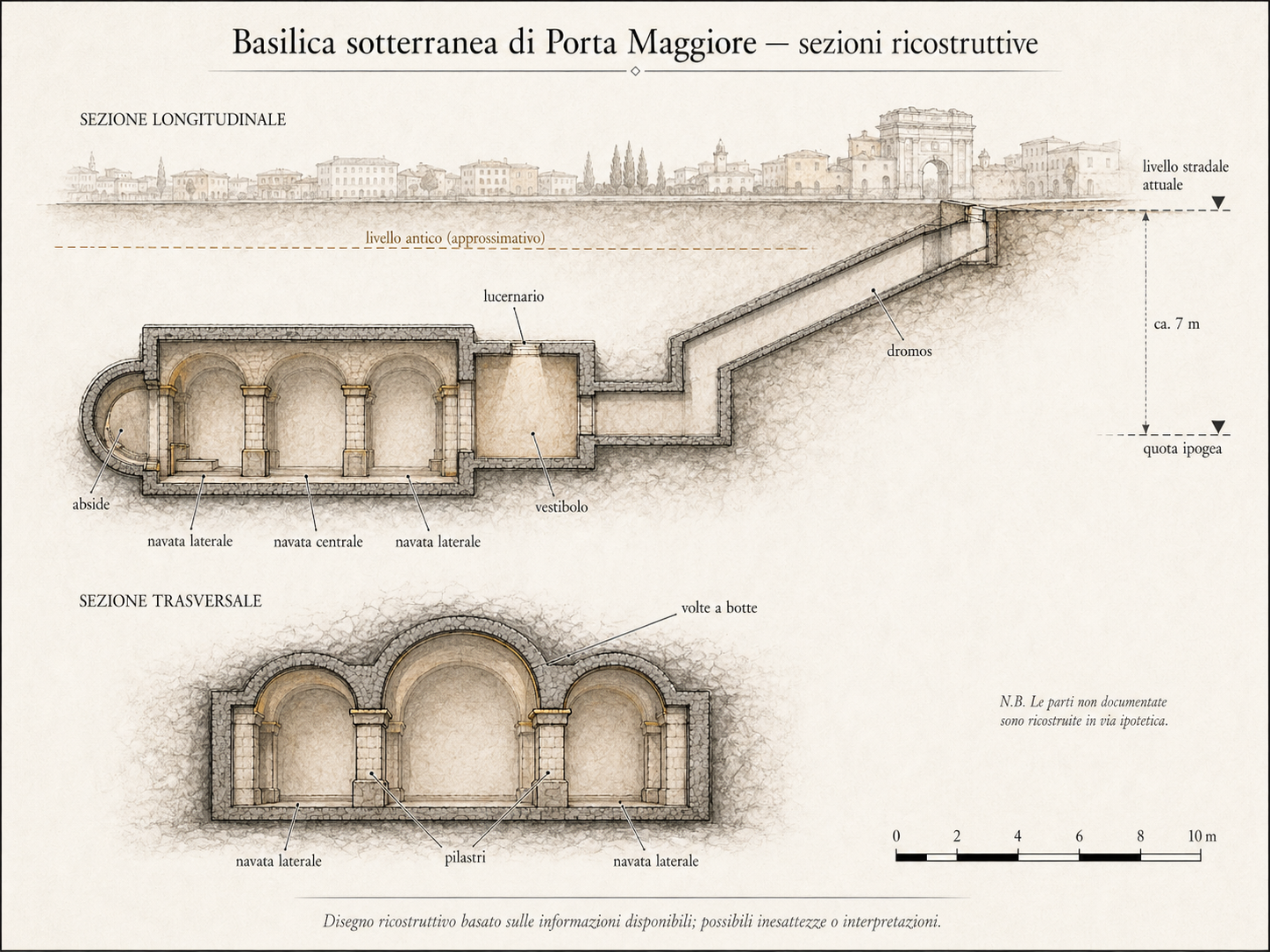
More precise information about the present state of the site clarifies an essential point: the modern building visible on Via Prenestina contains the access to the basilica inside it. There are no exterior stairs outside this building. Its roof corresponds essentially to the level of the railway track bed, which runs on an elevated structure; this raised condition can be seen on both sides of the brick access building.
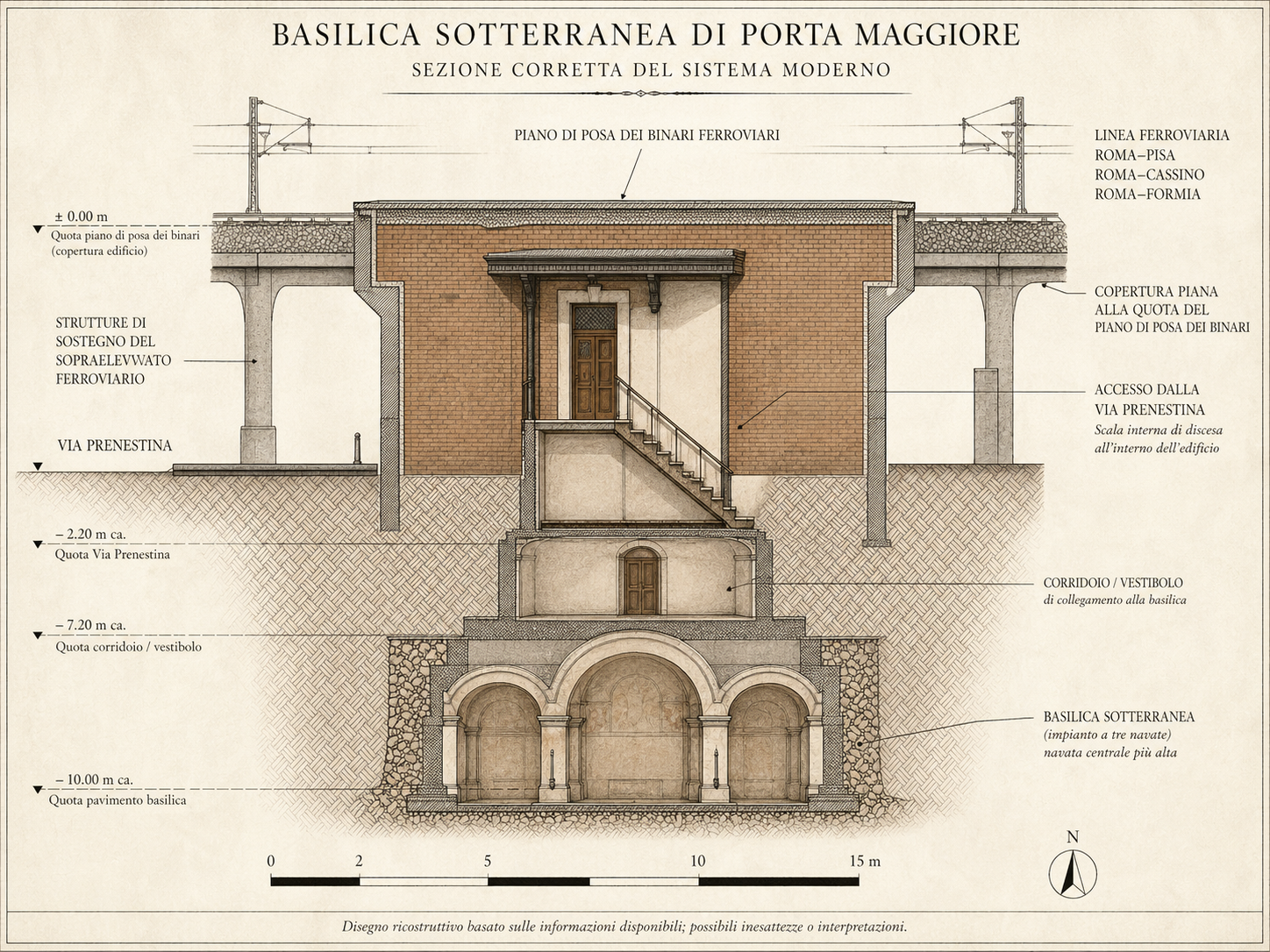
This relationship between the modern access building, the elevated railway and the hypogeum is crucial for understanding the visit. From outside, one sees a 20th-century brick structure; inside it begins a route descending to a Roman monument. The visitor does not enter through an ancient façade, but through a modern device of access and protection.
Construction technique and the hypogeal character
The creation of an underground vaulted hall required considerable technical skill. The available studies point to a process involving excavation and the creation of structural elements in concrete and masonry, later emptied or finished to form the interior space. The result was a stable, roofed environment, separated from outside noise and light.
The hypogeal character is not secondary. The descent, the vestibule, the dimness, the controlled light and the white stucco decoration together create a carefully staged sequence. The passage from the outer world to the underground hall was not merely functional; it changed the experience of those who entered.
Stucco, mosaic and mythical images
The decoration is one of the most extraordinary aspects of the complex. Walls and vaults were covered with white stucco and polychrome painting; the floor carried black-and-white mosaic. The subjects include mythological figures, fantastic animals, vegetal motifs, symbolic scenes and ritual objects.
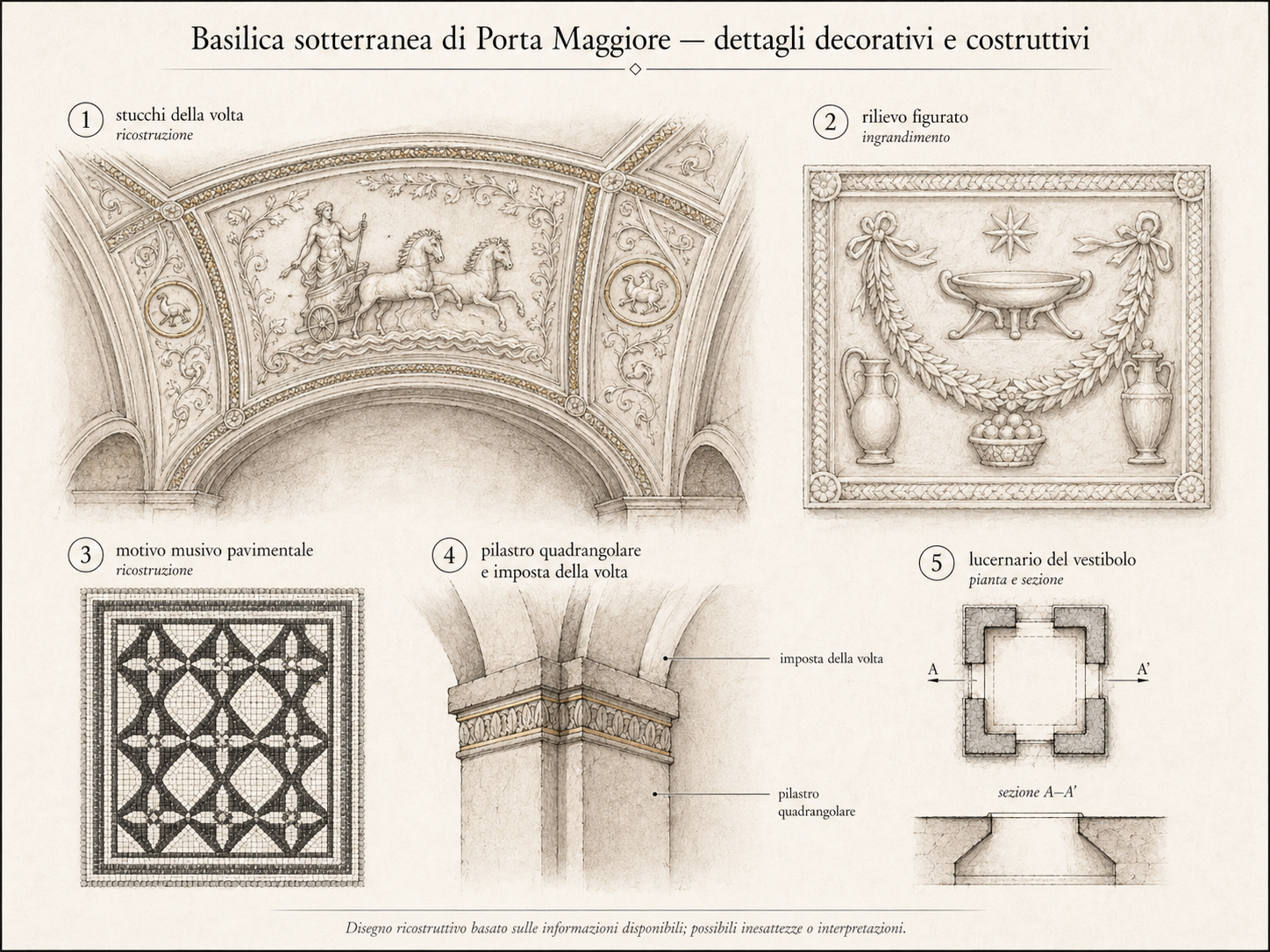
The interpretation of the imagery is complex. Some scholars have linked the iconography to the destiny of the soul, salvation, mysteries and the Neo-Pythagorean tradition. This reading is plausible and influential, but it does not remove all uncertainty: the building has also been interpreted as a funerary monument or more generally as a mystery-cult space.
The whiteness of the stucco had a strong visual impact. In an underground environment, where light was scarce and directional, white relief could stand out with exceptional clarity. Decoration was not merely ornamental; it helped transform the hall into a mental and ritual space.
The problem of function
The common label “Neo-Pythagorean basilica” is useful, but it should be used with caution. The monument’s function is not documented by explicit inscriptions. The Neo-Pythagorean interpretation rests on the reading of the architecture, proportions, decoration and 1st-century cultural context.
Several elements support an initiatory function: the descent, the preparatory corridor, the vestibule, the hidden hall, the centrality of light and the apse, and the iconographic programme linked to transformation and the fate of the soul. Other aspects remain open: we do not know for certain which group used the hall, how often it met, how many participants were present or how long the monument remained in use.
Archaeoastronomical research has added another layer of discussion, suggesting that solar and lunar light may have played a role in the design and ritual experience of the site. These hypotheses should be understood as interpretive contributions: valuable for exploring the complexity of the design, but not equivalent to definitive proof of cult function.
The interior today
Today the basilica appears as a fragile, protected, restored and controlled environment. Reading the hall requires attention: piers, vaults, mosaics and decorated surfaces coexist with traces of decay, restoration, protective systems and monitoring devices. It is not a theatrical ruin, but a delicate archaeological organism.
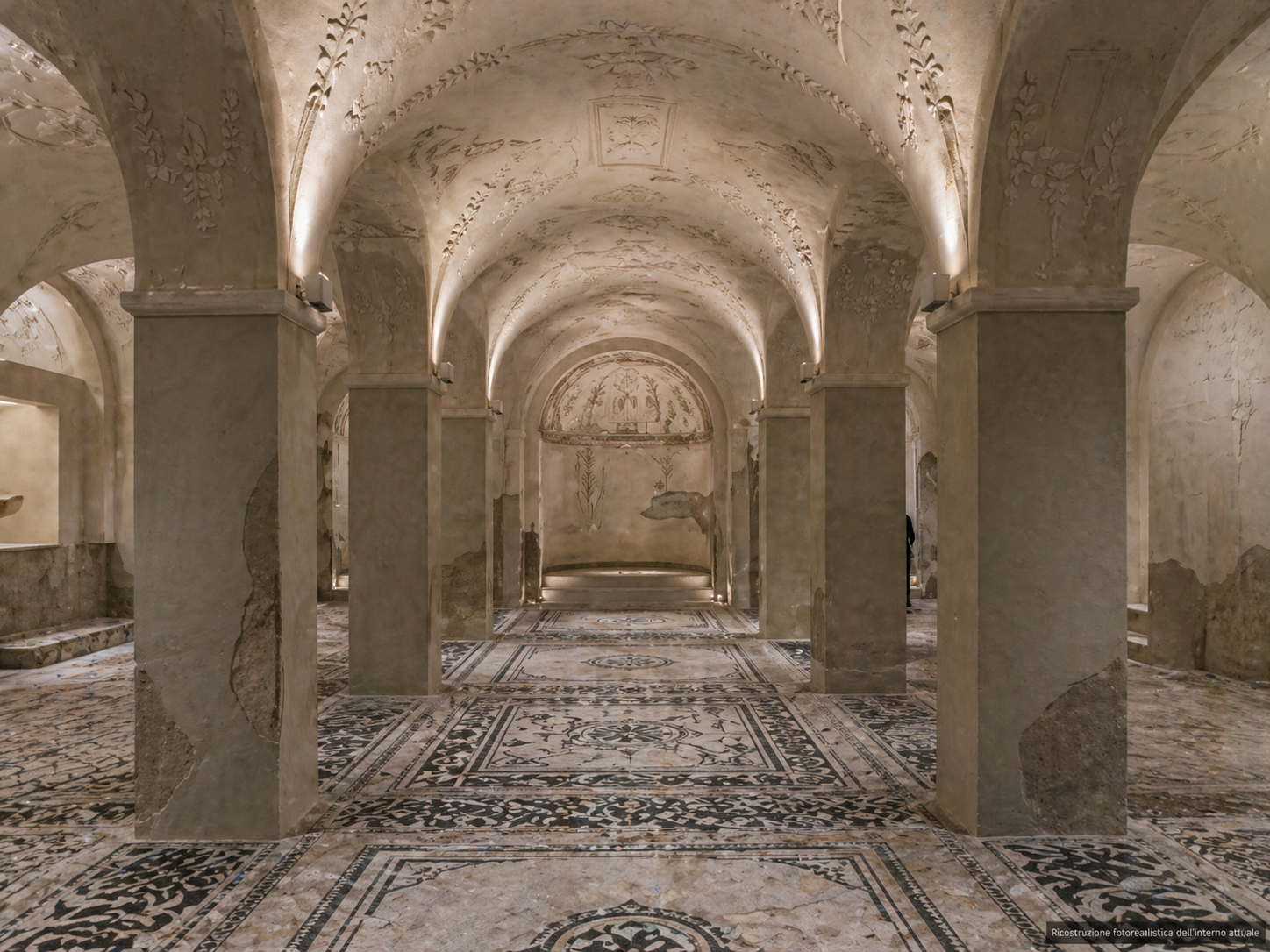
Conservation is affected by several factors: vibration, humidity, water infiltration, microclimate, salts and the vulnerability of the stucco surfaces. The modern structures above and around the hypogeum are not merely intrusions; in several phases they have also helped stabilize, protect and provide access to the monument.
How it may have appeared in antiquity
Imagining the basilica in Roman times does not mean inventing a theatrical setting. It means cautiously recomposing what the monument suggests: more intact surfaces, more legible stucco, more continuous mosaic floors, limited controlled light and strong separation from the outside world.
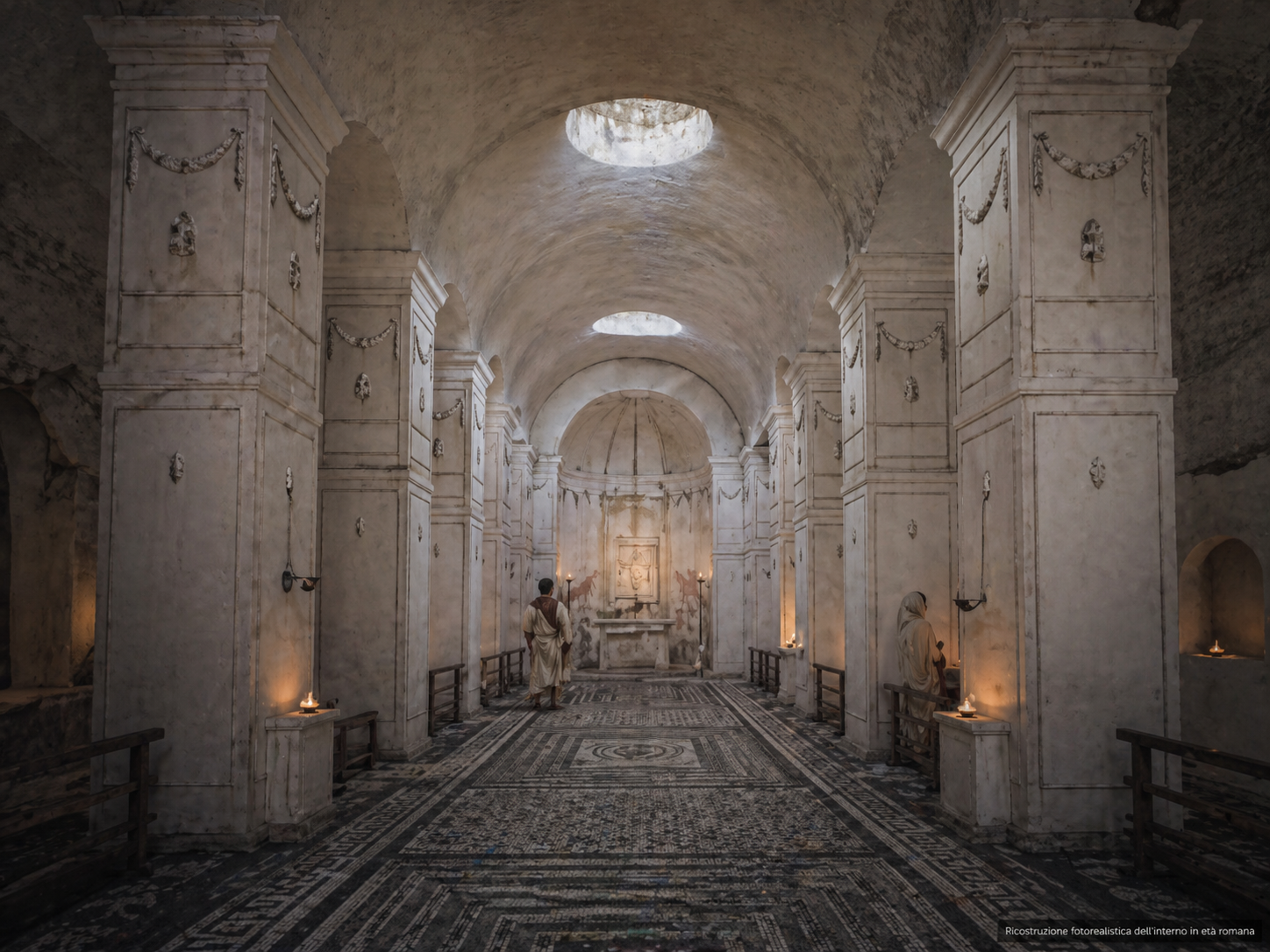
The ancient hall must have produced a very different effect from an open public building. The visitor or initiate descended, followed a corridor, passed through the vestibule and reached a closed, decorated, axial room. The experience was progressive and selective. The architecture did not announce itself from the outside: it revealed itself only to those who entered.
The basilica and the ancient landscape
Before the late antique and modern transformations, the Porta Maggiore area was an important infrastructural node. The Prenestina and Labicana roads, the aqueducts and the eastern suburban zones of Rome formed a landscape quite different from the present one: less dense, but already marked by large public works.
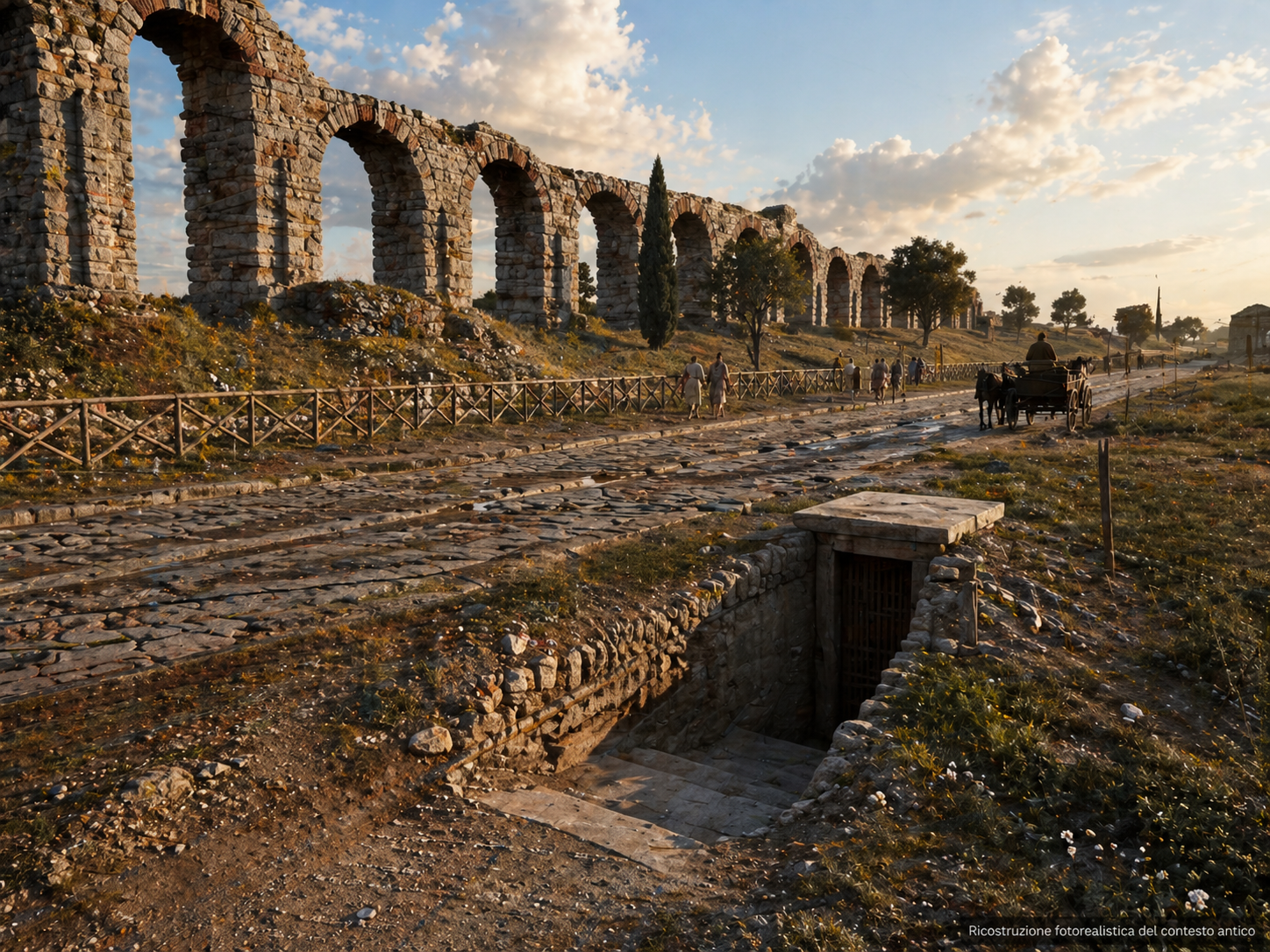
The underground presence of the basilica, close to monumental infrastructures, is one of its most interesting features. It was not designed to dominate the urban landscape, but to withdraw from sight. In this sense, its modern invisibility is not merely accidental: it repeats, in another form, an original characteristic.
Why it matters
The Underground Basilica of Porta Maggiore matters for at least four reasons. First, it preserves an early example of a three-aisled apsidal hall in a non-Christian context. Second, it documents a sophisticated use of underground space in Roman architecture. Third, it presents a stucco decorative programme of exceptional quality. Fourth, it forces us to think of the city not only as a surface, but as a layered system of infrastructures, hidden spaces, transformations and reuse.
Its value does not depend only on mystery. It depends on the questions it raises: how was an underground building designed? What role did light, proportion and decoration play? What kind of group would choose such a hidden place? How does an ancient monument survive within a modern infrastructure?
Those who pass the brick building on Via Prenestina can hardly imagine that a decorated Roman hall lies below the railway. This disproportion between external appearance and internal richness makes the basilica one of the most effective case studies for telling the story of underground Rome: a city not always visible, but still readable if one learns to observe levels, access points, walls, interruptions and urban anomalies.
Essential bibliography and resources
- Goffredo Bendinelli, Il monumento sotterraneo di Porta Maggiore in Roma. Contributo alla storia dell’arte decorativa augustea, in Monumenti Antichi della R. Accademia dei Lincei, XXXI, 1926.
- Jérôme Carcopino, La basilique pythagoricienne de la Porte Majeure, Paris, 1944.
- Salvatore Aurigemma, La basilica sotterranea neopitagorica di Porta Maggiore in Roma. Guida.
- Lucilla Labianca, Ida Sciortino, Silvia Gaudenzi, Andrea Patané, Vito Francesco Polcaro, Marcello Ranieri, “An Archaeoastronomical Study of the ‘Neo-Pythagorean Basilica’ at Porta Maggiore in Rome”, Archaeologia Baltica, 10, 2008.
- Treccani, “Basilica”, Enciclopedia dell’Arte Antica, with reference to the Porta Maggiore basilica.
- FAI, “Basilica sotterranea di Porta Maggiore”.
- Caperna and Anzini, studies on the Porta Maggiore area and its urban stratigraphy.